
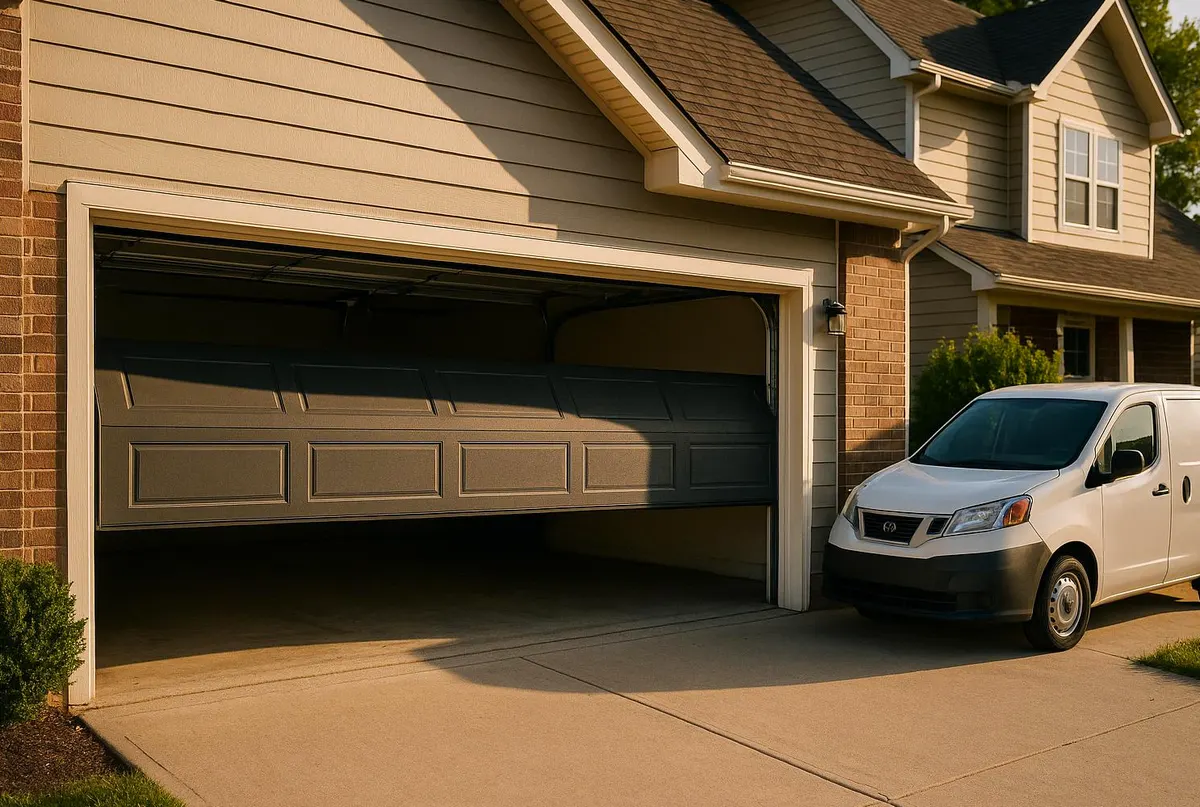
If your garage door starts down and pops back open, check the safety sensors first — they cause this more than any other part. The exceptions: if the door won't move at all, if it reverses only partway down the track instead of right near the floor, or if the problem only shows up after a storm or on humid afternoons, you're looking at a limit setting, a track issue, or spring tension instead of a sensor problem.
What the Different Symptoms Usually Mean
Garage door openers aren't guessing when they reverse — they're reacting to something. The pattern tells you where to look:
- Reverses immediately after the door is almost closed, right near the floor: usually the photo-eye sensors or the down-limit setting.
- Reverses partway down, mid-track: usually a physical obstruction, bent track, or a roller binding.
- Won't move at all, opener hums but door stays put: often a broken spring or a door that's too heavy for the opener to manage safely.
- Closes fine with the wall button but not the remote: points to the remote or receiver, not the safety system — a different problem entirely.
The Causes, in the Order a Technician Checks Them
1. Safety Sensors (Photo-Eyes)
These two small sensors sit a few inches off the floor on each side of the track and shoot an invisible beam across the opening. If anything breaks that beam — or if the sensors are misaligned, dirty, or fogged — the door will not close, or it'll start closing and reverse the instant it loses the signal. Humidity and afternoon downpours are common culprits here: condensation on the lenses, spiderwebs, or a lens knocked slightly out of alignment by someone bumping the bracket. The fix is simple — wipe both lenses, confirm both indicator lights are solid (not blinking), and nudge the brackets until they're facing each other dead-on. This takes minutes and costs nothing, which is why it's always checked first.
2. Obstructions in the Track or Path
Leaves, gravel kicked up during a storm, or a buildup of debris in the track can trip the sensor system or physically block the door. A quick visual inspection of both tracks, floor to top, usually finds it.
3. Opener Travel Limits and Force Settings
Every opener has settings that tell it how far to travel and how much resistance is acceptable before it assumes it's hit an obstruction. If these drift out of adjustment — common after age, a power surge, or DIY tinkering — the opener may reverse the door before it reaches the floor, thinking it's met resistance that isn't really there. Resetting these requires the opener's manual or a technician who knows the specific model; getting the force set too high defeats the safety feature, so this isn't a guess-and-check job.
4. Track Alignment and Rollers
Tracks that have shifted, loosened at their mounting brackets, or rusted from salt air near the coast can create just enough misalignment to bind the door partway through its travel. Rollers that are worn, dry, or off their track will cause the same symptom. This is a hands-on repair: re-securing brackets, replacing worn rollers, and in some cases straightening or replacing a bent section of track.
5. Spring Tension and Door Balance
A door that's gotten heavier than it should be — from moisture swelling a wood or composite panel, or rust adding weight to steel components — puts more strain on the springs and opener. If the springs are weakening or have lost calibration, the opener may struggle to control the door's descent and trigger a reverse as a safety response. This points to a spring adjustment or replacement, which should always be done by someone experienced with the tension involved.
6. Opener Logic Board or Circuit Board Failure
If everything above checks out, the opener's control board itself may be misreading signals or failing intermittently — more common in older units, especially ones that have weathered several hurricane seasons of power surges. At that point, repair or replacement of the opener is the practical fix.
When to Call Inglis Garage Door Experts
If you've checked the sensors and cleared any obvious obstructions and the door still won't close properly, it's time to call. We handle Off Track Door Repair for doors binding mid-travel, and full Garage Door Maintenance visits that catch worn rollers, loosening track hardware, and rust before they turn into a door that won't close at all — which matters going into another Florida storm season.
If your garage door in Inglis, Yankeetown, Crystal River, or anywhere else in Levy County is reversing, stalling, or refusing to close, give Inglis Garage Door Experts a call today for fast, honest diagnosis and repair.